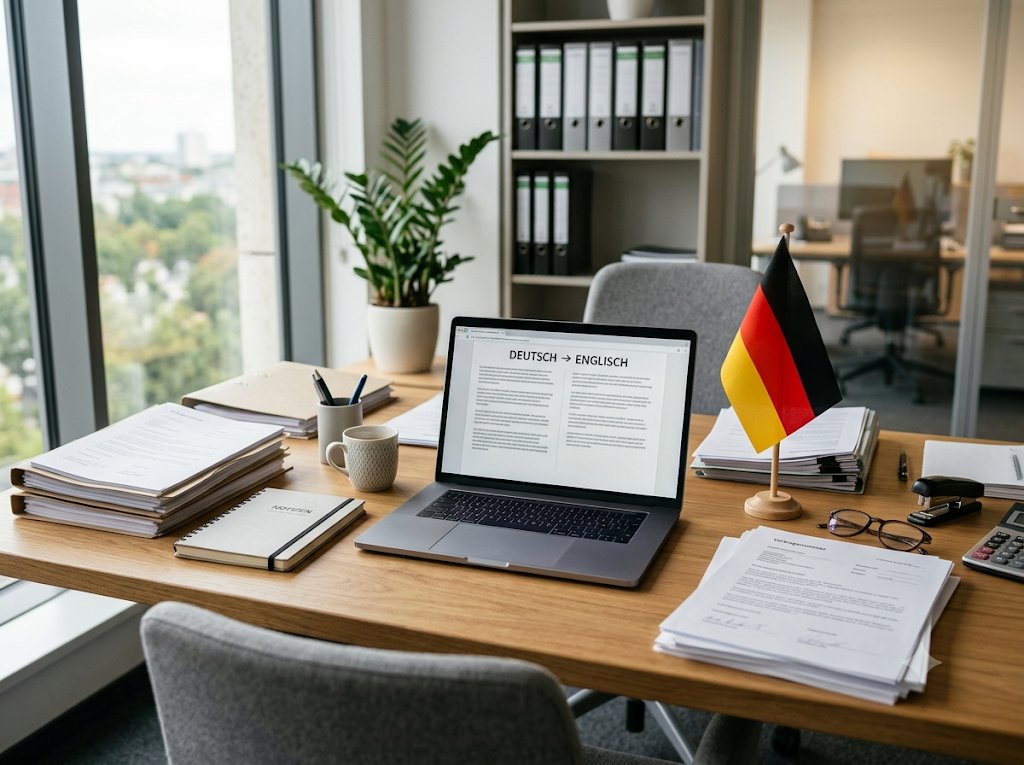
Businesses expanding into Germany, Austria or Switzerland quickly discover that a good German translation is about far more than swapping words between languages. German legal, technical and marketing writing follows conventions that a literal translation almost always gets wrong.
Why German Translation Is Harder Than It Looks
German sentence structure, compound nouns and formal register differ significantly from English. A German translation company that understands these mechanics produces text that reads naturally to a native speaker, rather than something that is technically correct but obviously translated.
A literal, word-for-word german to english translation often loses the original meaning of idiomatic or legal phrasing.
Common Reasons Companies Need German Translation Services
Contracts, product manuals, websites and HR documents make up the bulk of requests. Companies entering the DACH region (Germany, Austria, Switzerland) also need marketing material adapted, not just translated, since tone and formality expectations differ by region and industry.
Individuals commonly need german document translation for university applications, immigration paperwork, or family records such as birth and marriage certificates.
What Separates a Good German Translation Company From an Average One
A strong provider assigns native German speakers to translate into German, and native English speakers for the reverse direction, then runs a second linguist through the text for quality control. Reliable german translation services typically offer subject-matter expertise across legal, medical, and technical domains, along with certified german translation services for documents that must be accepted by an official body.
Certification matters more than most people expect. A translation without the correct signed statement can be rejected by a German registry office (Standesamt) or immigration authority even if the content itself is accurate.
German Legal Translation Has Its Own Rules
German legal translation requires a translator familiar with both the source legal system and German civil law terminology, since many legal concepts do not map directly between languages. Courts, notaries and government offices in German-speaking countries are strict about formatting and certification, so a generalist translator is rarely the right choice for contracts or court documents.
Pricing and Turnaround for German Translation
Rates for german translation services generally scale with subject complexity and certification requirements. A standard business document might take two to four working days, while long technical manuals or legal contracts take longer to preserve formatting and terminology consistency. Getting a written quote before work starts, including any certification fee, avoids surprises later.
For background on how the language itself is structured, the overview of the German language is a useful primer, and Germany Trade and Invest publishes practical guidance for companies entering the German market.
Working With a Provider Remotely
Because most german translation company work happens by email and secure file transfer, businesses rarely need a local office. A specialist agency, regardless of location, can usually deliver a certified german translation services package by post or courier just as reliably as an in-country provider, often at a lower cost.
Certified German Translation Versus Standard Translation
Not every document needs a certified german translation. Internal communication, marketing copy, and draft contracts usually only need a well-reviewed standard translation. But once a document goes to a German court, immigration office, or university, most institutions require a signed certificate of accuracy attached to the translation, sometimes alongside a sworn translator's stamp for court use. Confusing the two can mean paying twice, once for the wrong version and again for the correct one.
Checking the exact wording of the request before ordering saves both time and money. If a letter mentions "beglaubigt" (certified) or "vereidigt" (sworn), that is the signal to ask directly whether a provider can meet it.
Industry-Specific German Translation Needs
Manufacturing and automotive companies exporting to Germany often need technical manuals and safety documentation translated with precise terminology, since a mistranslated warning label carries real liability risk. Life sciences companies face similarly strict requirements for German regulatory submissions, where a single incorrect term can delay approval. A german translation company with subject-matter specialists across these industries is worth the extra vetting time.
Building a Long-Term Relationship With a Translation Partner
Companies with ongoing german to english translation and english to german translation needs benefit from working with the same provider over time. A shared glossary and translation memory mean product names, legal terms and brand voice stay consistent across every document, which speeds up delivery and reduces revision cycles on later projects.
Questions Worth Asking Before You Commit
Before hiring a german translation company, it helps to ask who performs the translation, whether a second linguist reviews the work, and how certification is formatted and delivered. A confident provider will happily share a redacted sample of past german document translation work, which gives a much clearer picture of quality than a price list alone.
Getting the right german translation services in place early, before a deadline or negotiation is looming, gives a company far more room to catch errors and confirm certification requirements than a rushed, last-minute order ever will.